How to teach a friend chess in one evening
Everyone who plays chess knows this moment. A friend sees you playing, gets curious, and says, “Teach me?” The danger is simple — most people start with a long list of rules, and within twenty minutes their friend is bored.
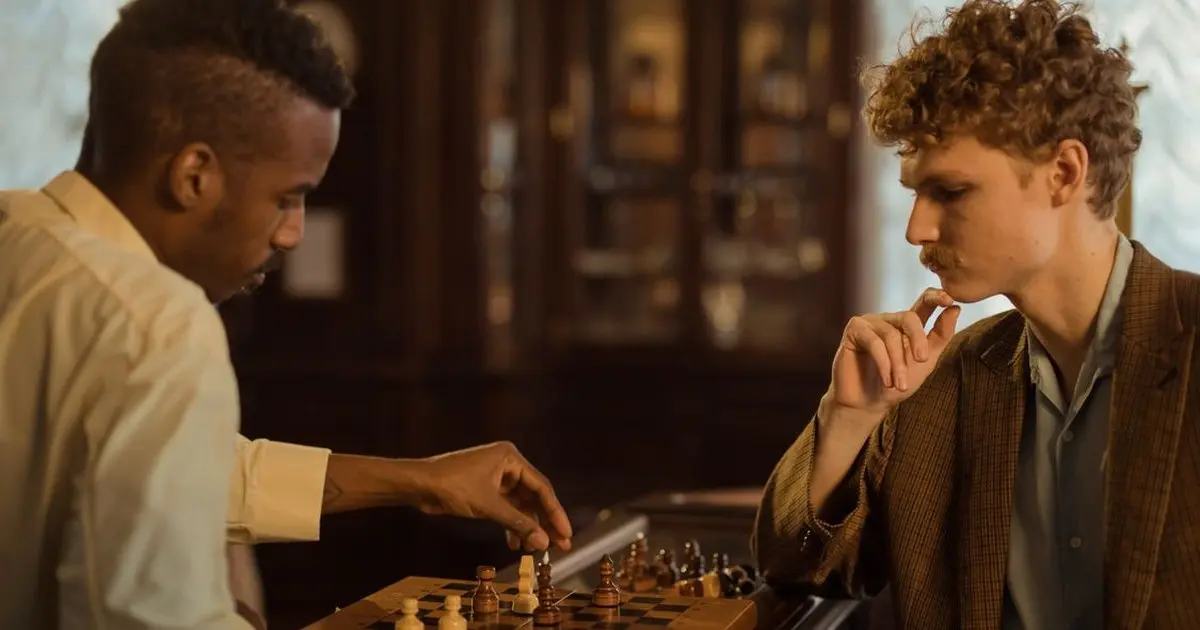
It does not need to be that way. In one relaxed evening, a complete beginner can learn enough to play a full, real game — and enjoy it. The secret is to play first and explain later. Here is the short plan.
The one rule that decides everything
Your aim tonight is not to make a strong player. Your aim is a finished game and a friend who says “one more” at the end.
If they understand most of the game and have fun, you have succeeded. The rest can come next week.
What you need before the evening starts
Almost nothing:
- A board and pieces, or just two phones. A real board is easier to learn on, but it is not compulsory.
- About two hours without any rush. Over tea, it feels like a game night, not a lesson.
- Patience from you, and the willingness to make the last game close and fun.
- No books, no homework, no preparation for your friend.
Step 1: Set up the board together (5 minutes)
Do not set it up for them — set it up with them. That itself teaches the board. Say only this:
- “White on the right” — the bottom-right corner is always a light square.
- The queen starts on her own colour.
- Back row: rook, knight, bishop, queen, king, bishop, knight, rook. Pawns go in front.
Then give rough values — pawn 1, knight and bishop 3, rook 5, queen 9 — and one line: “Protect your king. If he falls, the game is over.”
Step 2: Teach moves with mini-games, not lectures (30–40 minutes)
Nobody remembers a list of rules. Everybody remembers a game they just played. So teach every piece through a tiny game.
Start with the pawn game
Put only the pawns on the board. Pawns move one step forward (two on the first move) and capture diagonally. First to reach the other end, or capture all the enemy pawns, wins.
In five minutes they learn pawn moves, captures, and promotion — without any diagram. Play it twice.
Add one piece at a time
- Rooks: Move in straight lines, any distance.
- Bishops: Move diagonally only, and stay on one colour for the whole game.
- The queen: Rook plus bishop in one piece — that is why she is worth 9. Let them enjoy using her for a couple of minutes.
- Knights last: Two squares one way, one to the side, in an L shape. Knights jump over pieces — nothing blocks them.
- The king: One square in any direction, and he can never move into danger. That idea will become “check” very soon.
Skip opening names and strategy talk tonight. Tonight is only movement and fun.
The three special moves — teach one, mention two
- Castling: Teach it properly. King and rook move together for safety, once in a game. Beginners love it.
- Pawn promotion: They already saw it in the pawn game — reach the end and become a queen, almost always a queen.
- En passant: Only mention it. It is rare, and teaching it tonight will only overload them.
Step 3: Explain how a game actually ends (10 minutes)
Now they need only three ideas:
- Check — The king is under attack and it must be dealt with: move the king, block the attack, or capture the attacker.
- Checkmate — Check with no escape. The game ends.
- Stalemate — No legal move, but not in check. That is a draw, even if one side was winning.
Warn them now, so a won game does not slip away at the end. Skip resignations and other draw rules for tonight.
Step 4: Play the first full game — with training wheels (45–60 minutes)
Set up the full board and play a real game with four friendly rules:
- No clock. Time pressure teaches only panic at this stage.
- Take-backs allowed. When they make a big mistake, show what would have happened, then let them take the move back.
- Speak your thoughts sometimes. For example: “I am moving my knight because your bishop was aiming at it.” This gives them a look inside a player's mind.
- Use a handicap if you are much stronger. Play without your queen, or give them an extra advantage. A close game teaches far more than an easy win for you.
Do not try to play the cruellest move in a close final game. A friend who nearly wins is far more likely to ask for a rematch.
The mistakes almost every teacher makes
- Explaining openings. They do not need opening names tonight.
- Correcting every move. If you stop the game again and again, it stops feeling like a game.
- Using new words without explaining them. Words like fork, pin, and tempo can come later.
- Winning every game. Nobody comes back after being crushed every time.
Your evening, on one clock
| Time | What happens |
|---|---|
| 0:00–0:05 | Set up the board together |
| 0:05–0:45 | Pawn game, then one piece at a time |
| 0:45–0:55 | Castling, check, checkmate, stalemate warning |
| 0:55–1:50 | First full game with training wheels |
| 1:50–2:00 | One rematch challenge for next week |
Short on time? Keep only pawns, queen, and knight in the mini-games and you have a good one-hour version.
After the evening: keep the thread alive
What happens in the next seven days decides whether they become a regular player.
You can play chess online with friends in the browser in under a minute. Our full guide to how to play chess online with friends explains every step.
If they want a proper path, they can learn chess online lesson by lesson, at their own pace.
Send them one short chess puzzle a day. Once they enjoy those, share beginner chess tactics practice. When they ask, “Am I any good yet?” explain ratings with a guide to how chess ratings work.
Frequently asked questions
How long does it really take to teach a beginner chess?
About two hours for the moves and the aim of the game, using the mini-game method above. Playing well takes longer, but playing a complete game takes one evening.
Can I teach a friend if I am only a beginner myself?
Yes. Recent beginners often teach better because they remember what was confusing. You only need to be a little ahead of your friend.
What if my friend keeps making the same mistake?
Let it happen a few times. Losing a piece teaches more than a warning. Step in only when the same mistake is about to end the game too early.
Do I need a physical board?
No. A board is nicer for the first lesson, but phones or a laptop work fine — illegal moves are simply not allowed on screen, so the rules teach themselves.
What age can a child start with this method?
Most children from about six or seven can start, in shorter sessions of around thirty minutes. End while it is still fun.
The real finish line
By the end of the evening, your friend will not be a strong player — and that was never the goal. They will have moved every piece, played a full game, and hopefully lost at least once in a way that made them say, “one more.”
That is how every player starts: one person, one board, and one game that makes them want another. Tonight, you are that person.
Set up the board.